Part 12 of a 12-Part Series: Moments That Changed Wolverine History
By: Garrett Mitchell
Most people have at some point heard the old euphemism ‘it takes a village.’ The Woodruff High School athletic program has been among the most successful and respected in South Carolina for over 100 years. Numerous superstar athletes, an immortalized coach, and over two dozen state championships to its credit. But not everyone who has made profound impacts on such a storied institution have blown a coach’s whistle, worn a helmet and shoulder pads, put a basketball through the hoop, or hit home runs.
Some stars shine their brightest when others are not looking. Still, their glow nonetheless has illuminated the Wolverines’ incredible success for generations.
Without them, Woodruff athletics would have undoubtedly been far less successful, though their contributions are no less significant than those who have garnered the spotlight.

Every athletic program is fueled by players who are enthusiastic about representing their school with love for the game.
Clyde ‘Ham’ Werner knew this and dedicated his life to inspiring countless future Wolverines to take pride in their town, school, and its winning tradition. Werner became Woodruff’s first recreation director in the early 1960s, following his professional and textile league baseball career. Through his friendship and collaboration with Coach Willie Varner, he helped mold future Woodruff High players for over 20 years until his passing in 1984.
‘Ham’ Werner had a heart for the children of Woodruff.
“The midget league football season was going on at the same time as college football. Daddy would gather up all that wanted to go, all the midget football teams. On Saturday morning, some of the coaches and himself would take several carloads of kids to Clemson football games,” recalled Werner’s son, Joey. “It cost 10 cents to get in, and daddy would pay for every child to get in the game. My mother (Dot Werner) would make ham biscuits for everybody for the drive. Daddy made sure he didn’t leave any kid behind that wanted to go. He just wanted those kids to see what the next level looked like and create an interest and passion for that sport that might keep burning in them.”
Werner formed Woodruff’s first youth athletic programs, including midget league football and the youth basketball program that played in the old Abney gym. For many Woodruff youths it gave them something to look forward to and helped cultivate their love of sports which would continue driving Woodruff’s athletic teams for many years.
It was a labor of love for ‘Ham’. Never did he seek recognition for his efforts. The kids’ love of sports brought him great joy, and that was enough for him.
“That will forever live in my heart,” said Joey. “When I drive through Woodruff now, the first thing that comes to my mind is sports. This town was built around sports. It was a great era to live in, and I was blessed to have grown up in those years. Things were good, and daddy was a big part of that for a lot of children.”
Those early generations of Wolverines, and those who would follow, would also naturally need support from the community.
Betty Kelly, one of Coach Varner’s former basketball players and husband Dwayne, understood that. In the 1970s they would build, from the ground up, Woodruff High School’s first true athletic booster club, which helped fund the Wolverines’ thriving teams when Woodruff football was a true dynasty. The basketball teams were among the upstate’s best, baseball was contending for state championships, and wrestling and track and field were among the top 2A programs in South Carolina.
Betty’s tenure over the booster club lasted nearly a decade. It was her greatest passion, according to her son, Teddy Bryant.
“From what I remember, (Mom) just fully supported everything Coach Varner did and the whole athletic system,” said Bryant. “She worked with Coach Varner to get more people in the community involved and get more people coming to pep rallies and stuff like that. It started as fundamental stuff like that to selling things to help support team camps. She was behind us 1,000 percent and just slowly and gradually built that support into a big booster club.”
It costs money, often large sums, to keep the high school sports team functioning. Uniforms, equipment, team meals, camps, and transportation can cost many thousands of dollars. Through Betty and Dwayne’s efforts, Woodruff High School athletes never went without. A community fully behind its school, and an ambitious lady working tirelessly to raise money for its players, made sure that the Woodruff Wolverines had the very best. Betty’s legacy still lives on today.
“She built a big foundation,” added Teddy. “She had a lot of people to help her, and, you know, she was tremendous. Just to buy stuff for us and the teams that weren’t readily available like it is now, it was tough to get new stuff. Her efforts were very beneficial in helping all of the teams at Woodruff.”
Sports are all about numbers as well. Not just financially, but statistically, and for over 30 seasons, the Wolverines have had one of the best statisticians in South Carolina.
But keeping stats was never something Randy Grant expected he would be doing until Coach Varner approached him one day in 1979. He gave him the job on the spot.
“I was working in District 5 and was offered a job here in Woodruff in the spring of ‘79,” recounted Grant. “I taught eighth-grade history and English. Coach hired me to be one of the two junior high football coaches. The week before we went to the statewide coach’s clinic in July, we had a staff meeting. Coach Varner just told me I was going to be the varsity football statistician.”
As it turned out, Varner’s long-time statistician, Nyles Thomas, who had intended on retiring from the position, decided to stay on for a few more seasons. Grant worked alongside Thomas as an understudy for a few years before taking over himself in 1982.
Grant has his special method for charting games. Every play is documented, by hand, on a chart that denotes where each drive starts and each subsequent play along with yardage gained or lost and the play’s result. Varner wanted the complete game stats by Saturday morning. Each Friday night, Grant remained awake into the wee hours tabulating the numbers. It was, and is, a cathartic endeavor, according to Grant.
When Varner was relieved of his coaching duties in 1996, Grant voluntarily relinquished his role.
“I was, and always will be, loyal to Coach Varner, so I decided at that time it was best if I stepped away too,” he said.
But his hiatus would not last forever. When Freddie Brown was hired as the Wolverines’ coach in 2006, he approached Grant and asked him to return as the team’s statistician. Grant agreed with the condition, “that I could keep doing it the way I always had,” he said.
Grant has remained Woodruff’s stats and numbers guru every season from 2006 to the present day, sans the 2020 season due to health and safety concerns. He has charted the Wolverines’ stats for 35 seasons, including five state championship games and more exciting wins than he can count.
“I look forward to every season,” Grant said. “And I look forward to doing it again.”
Grant was not the only man in Coach Varner’s circle who was good with numbers, though.
With competitive athletics comes inevitable injuries, from bumps and bruises to more serious maladies. For 25 years, if a Wolverine was injured during a game, Dr. Guy Blakely was right there to mend their ailment.
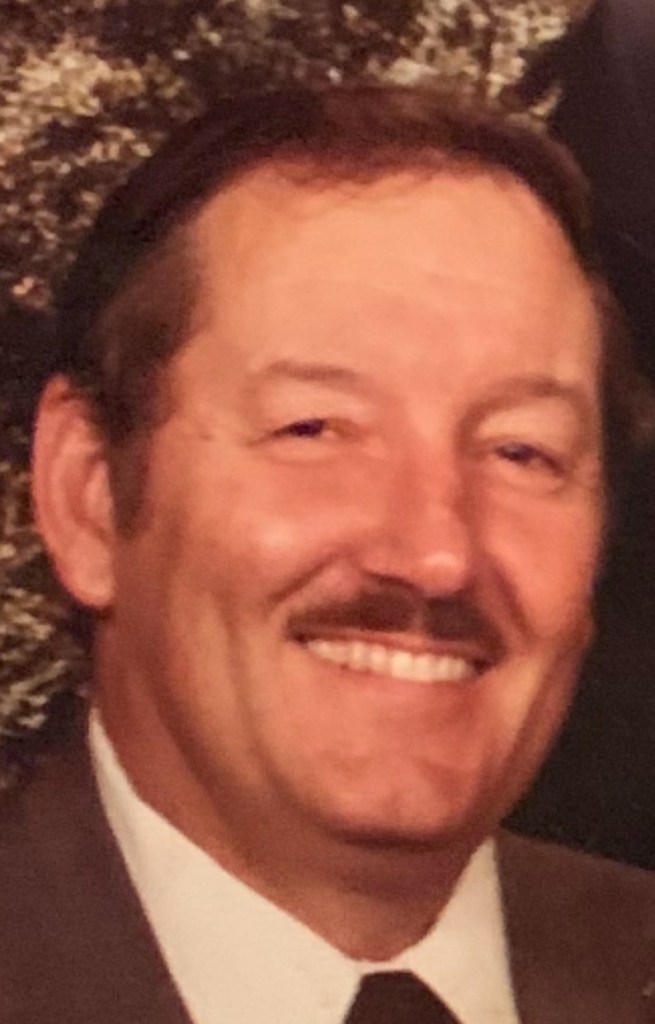
Dr. Blakely, a native of Clinton, opened his medical practice in Woodruff in 1963. By 1964 found himself a close friend of Varner’s and an ever-present place on the sideline treating the Wolverine wounded. No matter the sport, Doc, as he was affectionately known, always treated each athlete that came to him no matter what.
“It wasn’t just football,” noted Blakely’s son, Ashby. “He loved all sports and all of Woodruff’s athletes. He would give them physicals for no charge. My friends and teammates would come to our house for treatment. He was from Clinton, and they were our rivals, but he loved Woodruff, and he loved Coach Varner. He gave his time and talents because he wanted to see all of us advance.”
And Doc Blakely was very skilled at keeping more players on the field or court and had a patented method for doing so, the oft-dreaded Maroon-and-Gold shot. The shot was a mixture of cortisone and lidocaine for inflammation, and to numb the pain of minor injuries, Doc Blakely would give the injections right on the sideline so that players could get back in the game.
Medicine was not Doc Blakely’s only talent, however. He had a knack for correctly picking scores and accurately prognosticated the score of Woodruff’s 1980 title game victory over Swansea to a local reporter, too.
“He was a student of the game,” added Ashby. “He loved to be a part of it all. He thrived on helping folks and made sure he treated every player who needed it. He was involved in every aspect of sports in Woodruff.”
Every successful team has its unique voice, too.
For the countless thousands who have attended a game at Varner Stadium since 1968, the iconic call of Milton Smith announcing “Here come the Wolverines!” before the start of every game is synonymous with Woodruff football.
Coach Varner had a habit of giving people jobs with little to no consultation, with some keen intuition of talent mixed in. Hours before Woodruff’s biggest football game of 1968, he gave Milton his.
“We played James Island for the state championship on Thanksgiving Day in 1968,” Milton recalled. “Coach Varner came to me before the game and told me he needed a public address announcer since we were the home team. I was by myself on the third floor of the press box at the old Dorman High School stadium, and the James Island roster did not even include numbers for all of the players. They beat us 9-8 in driving rain. That is probably my most memorable game.”
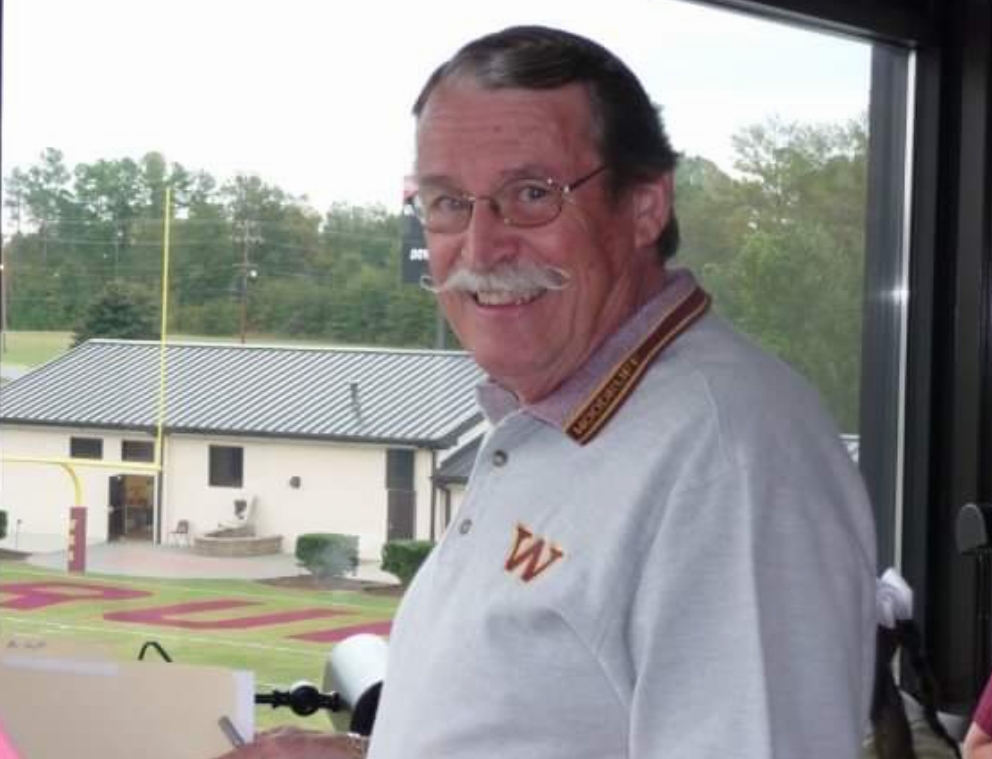
For Milton Smith, it was just the first of hundreds.
Smith has been a fixture behind the microphone for 54 seasons. He called half a dozen state championship games and bore witness to many all-time greats to wear a Woodruff uniform. He has one steadfast rule to announcing that he lives by; treat visiting teams not as an adversary but as a welcome guest.
“I always try to be nice to our opponents and their fans,” he said. “I want to be as respectful to them as I am to our team because ultimately, they are our guests. It’s what I’ve always done.”
The new Varner Stadium press box, built in 2009 after a lightning-ignited fire destroyed the original, was dedicated to Smith and his decades of service. It bears his name for all who enter Varner Stadium to see. Milton’s “golden voice”, as it has been described by many, is just as easy to hear.
“It was a tremendous honor for my family and for me to have the press box named for me,” Milton added. “I really and truly appreciated that.”
And at 82 years young, Smith is still going strong, with a voice as iconic and powerful as ever.
Yet another aspect of being a legend, at the helm of a dynasty no less, means that everyone wants a piece of your time.
Coach Varner was no exception to that formality, and so he turned to a decorated local journalist and publisher who just happened to be a big fan of Varner’s Wolverines.
John Gwinn was not only a friend to Varner but for many years served as the unofficial liaison between Varner’s program and the scores of media representatives seeking quotes and soundbites from him and his players.
To get to Varner, first, you had to go through Gwinn.
“John and Daddy had a solid friendship,” explained Varner’s daughter, Toni Sloan. “He was a journalist, but John really was partial to Woodruff and especially as his coverage was concerned.”
As Toni put it, you either loved Woodruff, or you hated it. Of course, that mainly depended on which side of the scoreboard a person’s team was on. However, no matter what, John served as a gatekeeper for the Wolverines and arranged and organized Varner’s media appearances and interview schedules. Moreover, he was also a close confidant and a man whom Varner trusted with his and his players’ well-being in the press.
“John was the translator, so to speak,” Toni said. “You didn’t get to Daddy without going through John Gwinn.”
With success comes recognition, and with so many people wanting their piece of the Wolverines, Gwinn was able to make order of the chaos.
“There was a lot of pride involved,” Toni added. “Everybody wanted a piece of the action, and everybody wanted to be part of that successful, winning community.”
John Gwinn made sure nobody got a larger helping than anyone else.
The history of the Woodruff Wolverines goes back over a century, long predating the Varner era and that which followed.
Naturally, Woodruff needed a historian to capture the past and the present for posterity. Mike Boyter was very good at doing that.
One of Varner’s best friends, Boyter was a fiercely loyal Wolverine. He collaborated with Varner and Randy Grant for many years to document the history of Woodruff athletics as told by the legions of former players who experienced it.
He was also Woodruff football’s official videographer and coached football in the school district as well.
“He never played football, but he loved the game,” said Stephanie (Boyter) Brown, Mike’s daughter. “Some of my best childhood memories were of him picking me up after school and taking me to the field. I loved watching him coach football.”
And on Friday nights, you could find Mike Boyter on top of the press box behind a camera. Boyter served as the Wolverines’ videographer for 25 years, from 1971 until 1996, and was also in charge of swapping films with the coaches of Woodruff’s future opponents.
Boyter, Varner, and Grant also spent countless hours documenting the Wolverines’ stories in a series of video-recorded interviews. Filmed in Varner’s living room, they were meant to document nearly a century’s worth of history. It was a project that went on for years following the end of Varner’s coaching career.
“He was excited to be a part of that,” Brown said. “They interviewed almost every legendary Woodruff athlete. They would all meet on Saturday mornings and do those videos. Reliving that history meant so much to him, and it meant a lot to Coach Varner.”
Boyter remained a loyal friend to Varner until the day he passed, with his last physical act coming with Varner at his bedside.
“We knew dad was going to pass away soon, and he wasn’t aware of much,” Brown recalled. “When Coach came in, he opened his eyes and shook Coach Varner’s hand, and then he went back to sleep. He just wanted Coach to be happy.”
There are those who have not only lived the history of Woodruff athletics but who continuing working to instill that winning pride and tradition into today’s Wolverines.
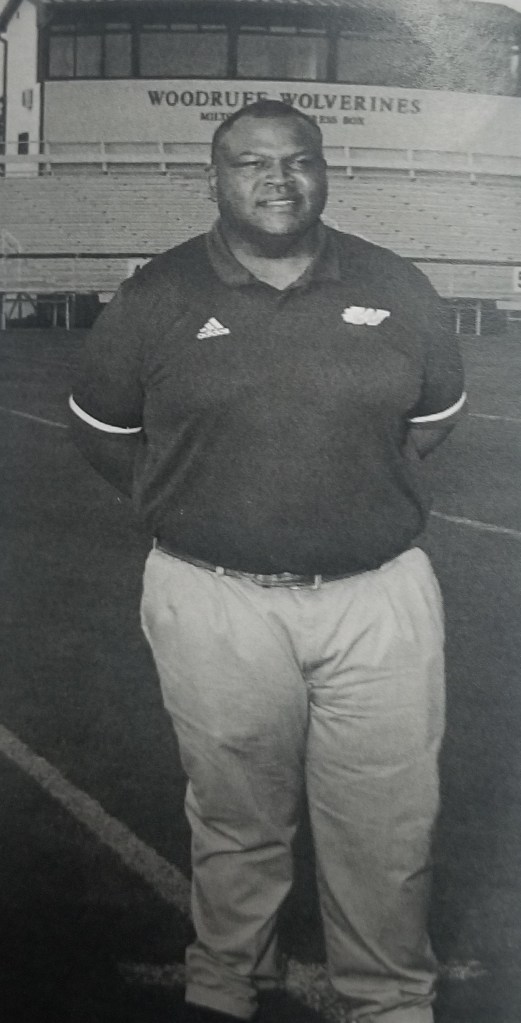
Duane Thompson makes it a point to do just that every time he steps onto the football field or track.
Thompson’s Hall of Fame career came in the waning years of Varner’s 42-year tenure as Woodruff’s football coach and helped lead the Wolverines to the 1993 state championship game as an offensive and defensive lineman before moving on to have an All-American career at Presbyterian College.
Thompson returned to Woodruff and, for the past 15 years, has served as an assistant football coach and head coach of the track and field program, giving back to new generations of Wolverine Nation.
“There’s nothing like it,” he said. “Playing here, the tradition, just the community surrounding you, it was every kid’s dream to play for Woodruff. When I came home from college, when I decided I wanted to coach, there was not another high school I would have ever considered coaching at than Woodruff.”
The ever-affable Thompson is beloved by players and throughout the community, with a personality as large as his physical stature. He commands players’ attention and uses those windows of opportunity to teach today’s youngsters what it truly means to be a Woodruff Wolverine.
“Now, when you come back here, and you’re back in the community trying to give back, those are the same things we are trying to teach,” said Thompson. “At the end of the day, the biggest thing is getting these kids to understand, yes, you’re playing football, but what we want you to do is be successful in life. I take those lessons I learned back then and try to prepare our kids. Yes, we want to win football games, but I want them to win at life.”
These are but a few of Woodruff High School’s unsung heroes.
These men and women combined their talents, helped build, and continue to build, a program cemented in class, integrity, and success.
The most basic tenet of a symbiotic relationship is that the program as a whole is but a sum of its parts, all working toward a common goal. From the beginning, the Woodruff Wolverines and those who support them in myriad ways have personified this philosophy.
Without them, there would be no moments that have changed Wolverine history and no stories to tell.
That is their most incredible legacy, and for those who continue to carry the torch, well…
Their history is still in the making.

Author: Tracy Sanders





Woodruff Booster Clubs started in the 60’s. I’m sure that many people remember having Woodruff Wolverine Booster Club Stickers on their vehicles.