
By: Garrett Mitchell, Staff Writer
garrett@thewoodrufftimes.com
George Reitmeier could see Cherbourg just five miles away. He watched from the SS Leopoldville as the French coastline drew closer.
On December 24, 1944, George was a world removed from his home in Buffalo, NY, and his family’s Christmas celebrations. Instead, he was on his way to battle with the 66th Infantry Division of the United States Army, bound for the Battle of the Bulge as reinforcement for the allied offensive against the German Wehrmacht as World War II raged in Europe.
In an instant, his thoughts of home were shattered by a violent explosion on Leopoldville’s starboard side that rocked the great ship back on its keel. German U-Boat 486 had fired two torpedoes at the Belgian passenger ship, which had been repurposed as a wartime troop transport vessel. The second volley scored a direct hit just aft of amidships, mortally wounding the ocean liner. The ship carrying over 2,000 American soldiers, which had already made 24 crossings of the English Channel from Southampton, England, would never make it to Cherbourg.
Seven hundred sixty-three young men would never make it there, either.
George had been proactive about joining the military during the war. As a high school senior in 1943, he decided that joining the service voluntarily might afford him more autonomy in choosing where and how he served. He decided to become an Army engineer. He was accepted into the ASTP, or Army Specialized Training Program, and sent to the University of Missouri to begin his studies following basic training at Fort Benning in Georgia.
“I was due to graduate in June of 1943, and I knew that as soon as I graduated, if I didn’t do something on my own, I would be drafted and put wherever the government wanted to put me,” he explained. “So, I thought about this, and a recruiter from the Army came to the school I was going to, which was an all-boys technical high school, and he said that the Army needed engineers and was setting up a program called the Army Specialized training program. In this program, if you got into it, they would send you to college. That was alright as far as I was concerned. After you graduated, you would be given a second lieutenant commission and be obligated to serve four years in the Army as an engineer. It sounded like a good option, and I decided to do that and went into the Army in September 1943.”
Reitmeier’s education was supposed to take two years. Maybe the war would be over by then. But as Europe burned under Germany’s onslaught and the allied counteroffensives that followed, rumors began circulating around campus, said George, that the Army would disband the ASTP and prepare him and his classmates for combat.
“Part way through the first semester, we began getting rumors that the Army was going to discontinue our program,” said Reitmeier. “When the semester ended, they sent all the ASTP boys to Fort Smith, Arkansas, to decide what they were going to do with us. They decided to send us all to Fort Rucker to join the 66th Infantry Division. We all got together for advanced infantry training, and one of the veterans from the Africa campaign came to train us. He said when he first met us, ‘Ok, you college boys, now that you had your college education, we’re going to teach you how to kill people.’”
Reitmeier and his friends refined their fighting skills at Fort Rucker, Alabama. In October 1944, the call came that he and his fellow soldiers would be sent to Dorchester, England, to begin combat training as part of F Company, 264th Infantry Regiment, 66th Infantry Division. Arriving in Britain, the 66th began hedgerow training drills that would acclimate them to the terrain and conditions in France. Then, as Christmas approached and with the Allies facing heavy casualties at the Battle of the Bulge, the fateful call came.
“On December 24, 1944, we were notified that we were leaving immediately for France because reinforcements were needed at the Battle of the Bulge, so off we went to Southampton,” continued Reitmeier. “The division was put on a series of ships with the various units on different ships depending on their purpose. I was put on the Leopoldville.”
George boarded Leopoldville with another 2,234 U.S. soldiers, and the ship departed Southampton on Christmas Eve morning flanked by an escort convoy of Allied naval destroyers. While high-ranking military officers and officials in France celebrated the holiday, Reitmeier was on his way to war thousands of miles from home. But as Leopoldville neared the coast, U-486 zeroed in undetected. The torpedo slammed into its side with devastating precision at 6 p.m. though it was not initially clear how badly the ship had been damaged. However, it did not take long for Reitmeier and his comrades to figure out the direness of their straits.
George vividly remembers the chaos, then being abandoned by the Belgian crew whose only orders to abandon ship were spoken in Flemish, a language most of the young men did not understand.
“We were within five miles of France, and all of a sudden, there was a tremendous explosion,” he said. “It was determined by word of mouth that the Leopoldville had been hit by a torpedo, obviously from a German submarine. A big hole had been blown in the side of the ship, and all the power for the ship went out. No power, no propulsion, no nothing. It was slowly beginning to sink.”

He continued, “After about 20 minutes or so, word got out that the captain had said to abandon ship, and it was every man for himself. The crew lowered lifeboats and got in them, and the rest of us were left to our own devices. We tried to lower more lifeboats, but we didn’t know how they worked, and we couldn’t get the darn things down. Panic took over right about then, and a lot of men were very fearful because they couldn’t swim. People were praying for help because they didn’t know what to do. It was total mayhem.”
As the crew launched lifeboats and rowed away from the sinking ship, thousands of soldiers were left behind, Reitmeier among them. Only a handful of men could jump into lifeboats as they were lowered by the fleeing crew. For those left on board, many remained unaware that their ship would, in fact, sink. Those who did realize it still believed help would come from Cherbourg.
Those hopes, tragically, were in vain. Help would not arrive from land in time to save those stranded aboard Leopoldville. Then, from out of the twilight appeared a British destroyer that had been part of the escort convoy.
HMS Brilliant pulled alongside the now-heavily listing behemoth and initiated a desperate, last-ditch rescue attempt.
“After about half an hour, the British destroyer came alongside the Leopoldville, and they couldn’t tie the two ships together, but the captain (of HMS Brilliant), I thought, did a remarkable job as he tried to keep his ship close to the Leopoldville,” recollected Reitmeier. “It was not an easy thing to do. Sailors aboard the destroyer were yelling at us to get off the ship. They threw ropes over, and men tried to climb down. Some made it, and some didn’t because they couldn’t hold onto the ropes anymore and fell off into the water.”
Soldiers began jumping from the deck of Leopoldville toward Brilliant, but with rough seas, the two ships would crash into one another, drift apart on a swell, then repeat the same deadly dance over and over. Many who jumped mistimed their leap, said Reitmeier, and fell between the two ships and plunged into the frigid 48-degree water of the English Channel. Many were crushed between the two colliding metal hulls, and those who were not faced freezing to death in the icy waters.
As the rescue continued, explained Reitmeier, “Some started trying to jump to this destroyer, but the ships couldn’t keep together, and if they jumped when the ships were moving apart, they fell between them into the water and were gone.”
George added that he waited until the last moment. By timing how long the two ships stayed apart, then came together, Reitmeier was able to calculate exactly when to jump. The last thing he remembers is throwing himself over the side of the Leopoldville and falling some 40 feet toward the deck of HMS Brilliant.
“Quite a few made it because they were smart enough to see when the ships came together and then jumped,” he stated. “It was quite aways down to the deck of the destroyer. After looking at all the options, I thought I didn’t want to get in the water. I thought jumping was probably the best bet. I walked up to the edge and waited until I could see the ships coming together, and when I saw they were moving close, I jumped.”
He continued, “I landed on my feet, I assume somewhere on the deck of the destroyer. The last thing I remember is my knees coming up toward my face very fast. Then everything went black, and I don’t remember anything. I guess I knocked myself out.”
Two and a half hours after U-486 fired a single torpedo into the Leopoldville, the great ship finally foundered. Going down by the stern, she slipped beneath the roiling waves of the channel and was gone. Of the American soldiers on board, 763 lost their lives. Five hundred fifteen men went down with Leopoldville, and 248 succumbed to injuries or hypothermia. Reitmeier was one of the lucky ones and only learned about his harrowing escape after waking up in a military hangar with many of the survivors.
“I do have some memories of waking up in what looked like an aircraft hanger covered in a blanket,” Reitmeier said. “Then, things started to clear a little bit, and they were trying to feed me, and I was hungry and thirsty. I thought this was pretty good. They tried to send many of the survivors back to their original units, and they asked us what unit we were from.”
After recovering, Reitmeier and what was left of the 66th Infantry Division were refitted with new gear and clothing and briefly sent to the Ardennes. The Battle of the Bulge had turned in favor of the Allies, so Reitmeier and others from the 66th were then sent to Lorient, Brittany, along the western French coast, where they would finally earn a small measure of justice for the lives lost on the Leopoldville during the Brittany campaign.
George and his fellow soldiers served out the remaining few months of the war by holding down German forces along the coast and keeping at bay a docked fleet of German U-Boats who were now unable to flee into the Atlantic and destroy more ships and lives.
“We went into Brittany and surrounded what was estimated to be around 100,000 Germans in the coastal cities of Saint Nazaire and Lorient, which were major German submarine bases,” he said. “They had bases there where they could take care of 30 to 40 submarines at one time. We surrounded them and kept them there, the idea being that trying to get in and dig them out was going to cost a lot more lives than it was worth. Just keep them there until the war ended and Germany surrendered. That’s what we did.”
After the European war ended on May 8, 1945, George stayed behind in France to assist in moving troops back stateside before being transferred to Linz, Austria, to build a camp for displaced persons. He finally returned to his home in New York in 1946.
It has been 79 years since the tragedy of the SS Leopoldville. In June of 2023, George returned to France once more and to the place where he nearly lost his life and where thousands of young men gave theirs to the cause of peace and freedom. It was his third trip back since the end of the war. His first return, in the 1960s, brought Reitmeier full circle with his first calling as an engineer.
“My company in Buffalo was involved in building the communications stations in Andover, Maine, and one in Pleumeur-Bodou, France,” said Reitmeier. “It was called the Tel-Star Communications System, and it was the first satellite communication system in the world. The first message went from Andover up to the satellite and down to Pleumeur-Bodou in France. Then they sent a message back to the U.S., and that was the first satellite communication ever. While we were building that station, one weekend, I took a ride over to Lorient to see what I could see, and things had already changed, and I didn’t recognize very much. I came back kind of empty-handed.”
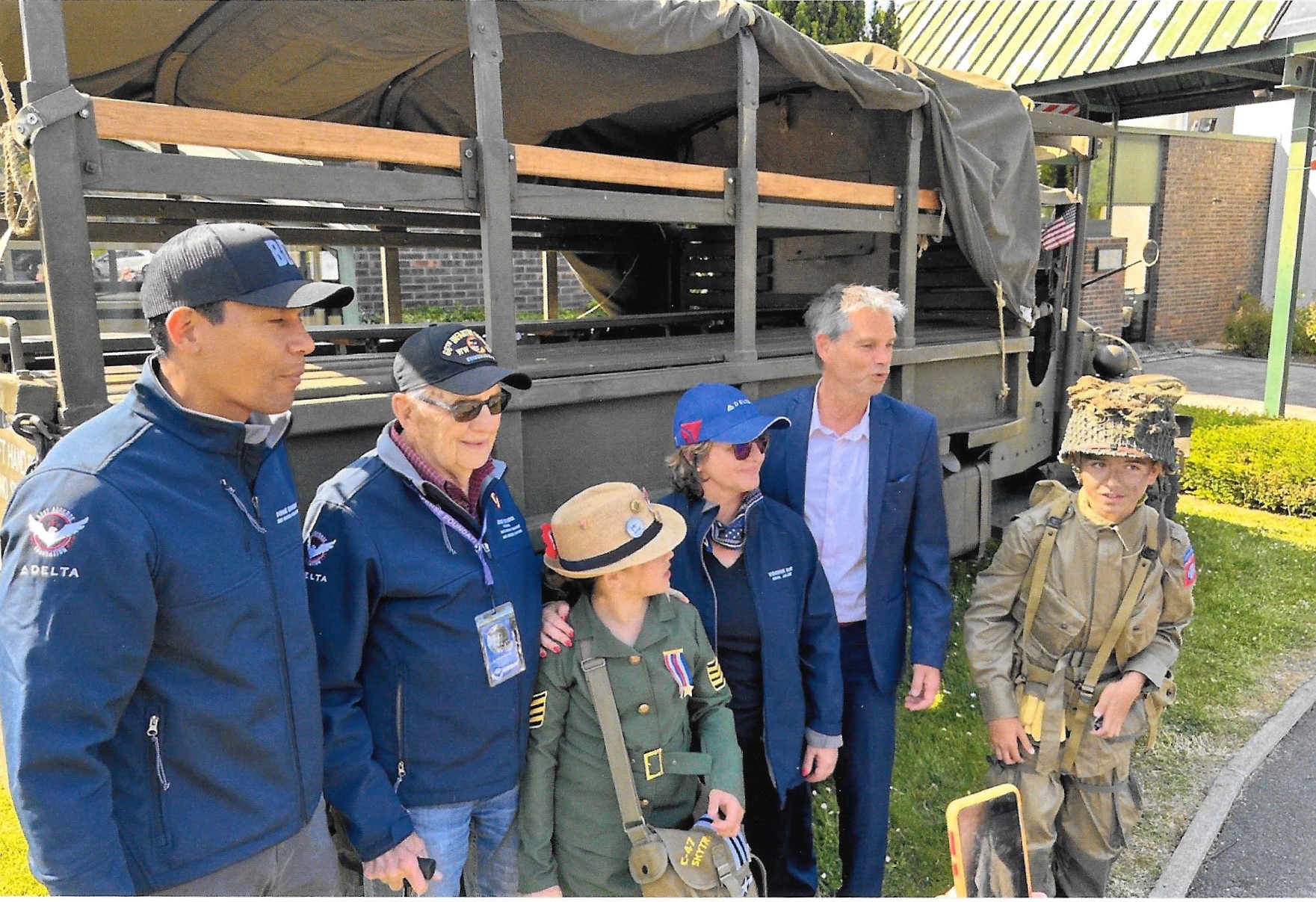
He returned in 2019 and again this year as part of commemorative ceremonies held by the Best Defense Foundation. George admits that every trip back to France has been emotional. It has also been a blessing. The center where he helped establish the first satellite communications is now a museum, the first of its kind in Europe. He also visited the United States Cemetery at Omaha Beach in Normandy for a special ceremony. He spoke to over 1,200 French school-age students to tell his story and share his experiences during the war.
Everyone, says George, has given the warmest reception for the heroes who fought there almost eight decades ago.
“There were people clapping and cheering, wanting to take pictures and give you a hug,” he said. “You can say all the fancy words, beautiful, spectacular, gorgeous, and you couldn’t put them all together to tell you how this trip was. This trip was just something else. It was just great to go back with a group of other veterans and visit these places again.”
Now 98 years old, George looks back on his wartime service with a strong sense of solemnity. The memories of Christmas Eve 1944 and the months that followed still haunt him. It is a feeling he doubts will ever fully go away, but something he has made peace with.
“It was a part of my life that was daily living under these combat conditions,” concluded George. “Going back, you kind of get that uneasy feeling again. When we went through the cemetery on Omaha Beach, our guide knew I was part of the 264th regiment of the 66th Infantry Division, and she pointed out quite a few graves from the 264th, which were my guys who didn’t make it. It isn’t something I can ever forget.”